
A105 Flanges
First Distributors offers a wide range of A105 flanges and can typically provide the following for same-day or next-day delivery. Large quantities and, custom sizes may be subject to a longer lead time for delivery.
Items Typically on the shelf:
| Size Range: | 1/2" - 48" Diameter |
| Class: | 150 through 2500 |
| Carbon Steel: | A105 |
A105 Forged Carbon Steel Flange Material Specification (ASTM A105)
Chemical Composition
| Element | C (max) | Mn | P (max) | S (max) | Si | Cu (max) | Ni (max) | Cr (max) | Mo (max) | V (max) |
|---|---|---|---|---|---|---|---|---|---|---|
| Composition, % | 0.35 | 0.60-1.05 | 0.035 | 0.04 | 0.10-0.35 | 0.4 | 0.40 | 0.30 | 0.12 | 0.08 |
- The sum of copper, nickel, chromium, molybdenum and vanadium shall not exceed 1.00%.
- The sum of chromium and molybdenum shall not exceed 0.32%.
For each reduction of 0.01% below the specified carbon maximum (0.35%), an increase of 0.06% manganese above the specified maximum (1.05%) will be permitted up to a maximum of 1.35%.
Manufacturing Consideration
Heat treatment is not mandatory requirement except:
- Flanges above Class 300
- Flanges of special design where the design pressure at the design temperature exceeds the rating of Class 300.
- Flanges of special design where the design pressure or design temperature are not known.
Heat treatment, when required shall be annealing, normalizing OR normalizing and tempering OR quenching and tempering in accordance with ASTM A961
A Guide To Flange Materials
Connection Types Explained (Type Of Flange)
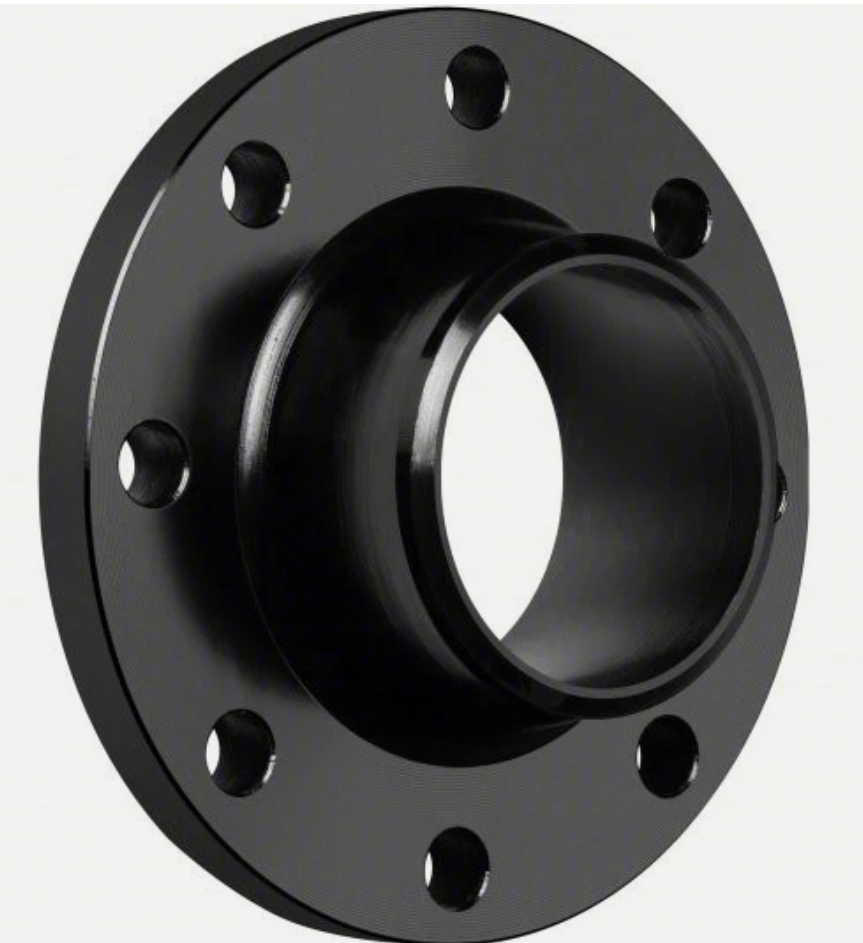
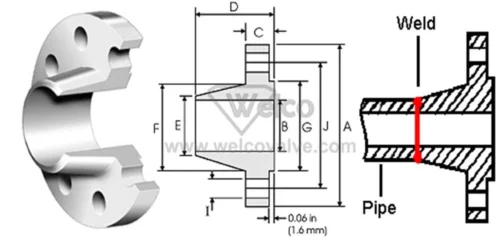
Weld neck
The bore of the pipe and flange match in order to reduce turbulence and erosion, thus making it the strongest connection type and the most favorable in critical applications.
Slip-on
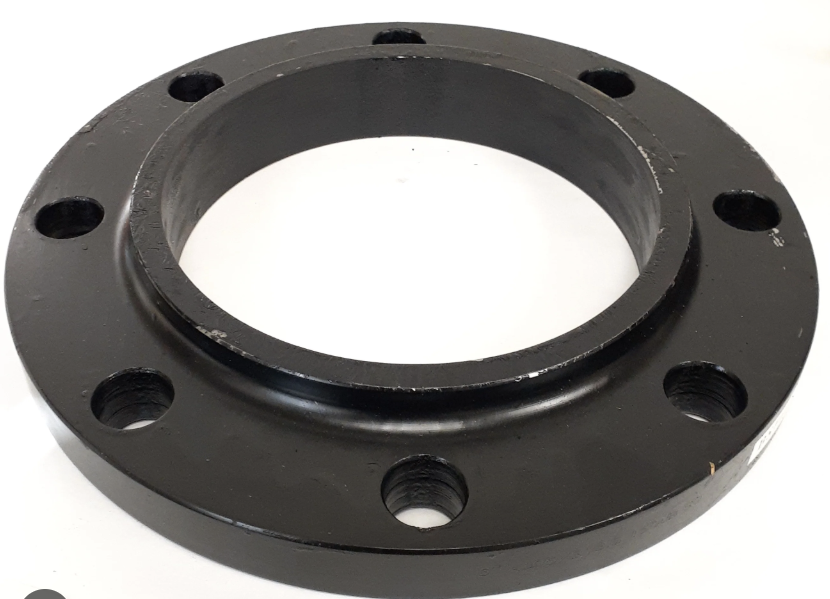
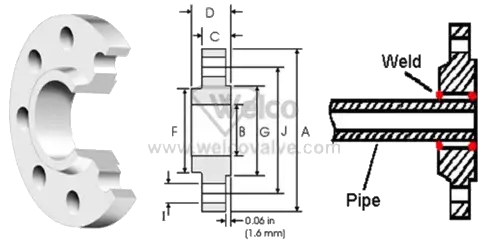
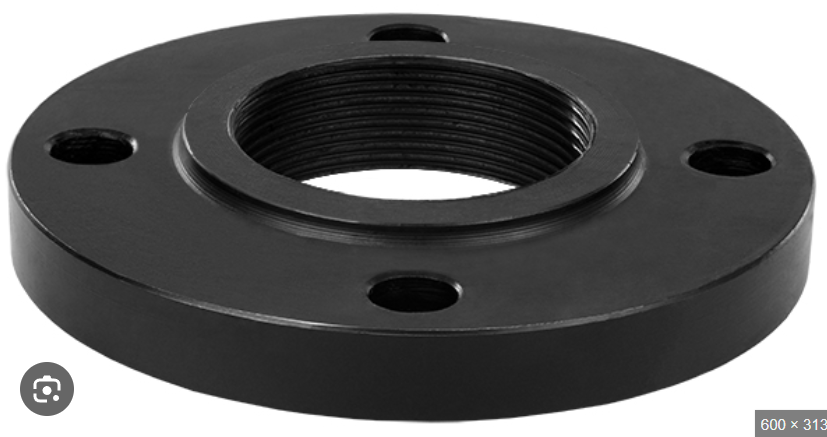
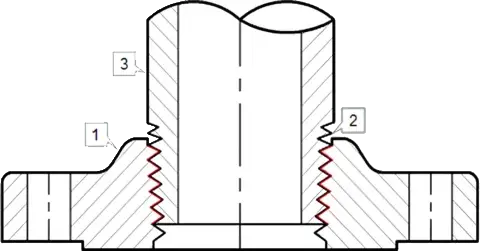
Threaded
Blind
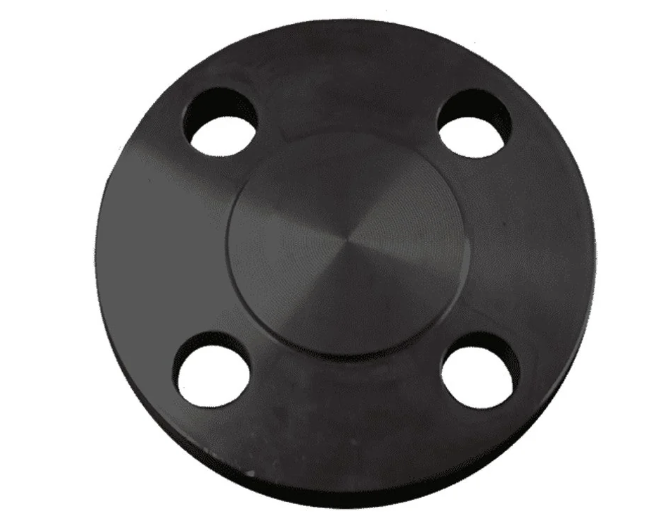
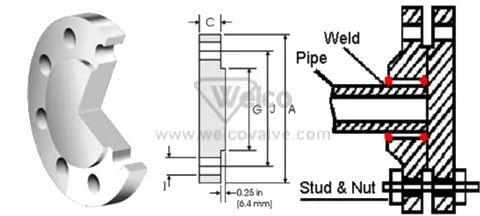
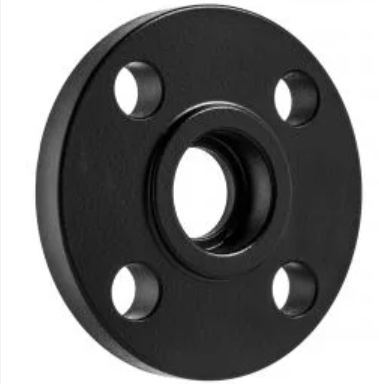
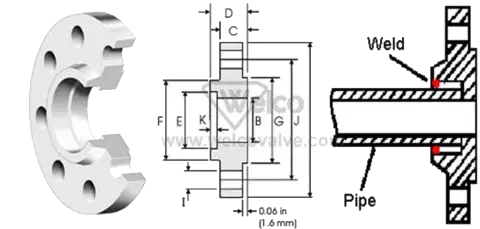
Socket weld
The bore of the pipe and flange match, thus providing good flow characteristics.
Lap joint
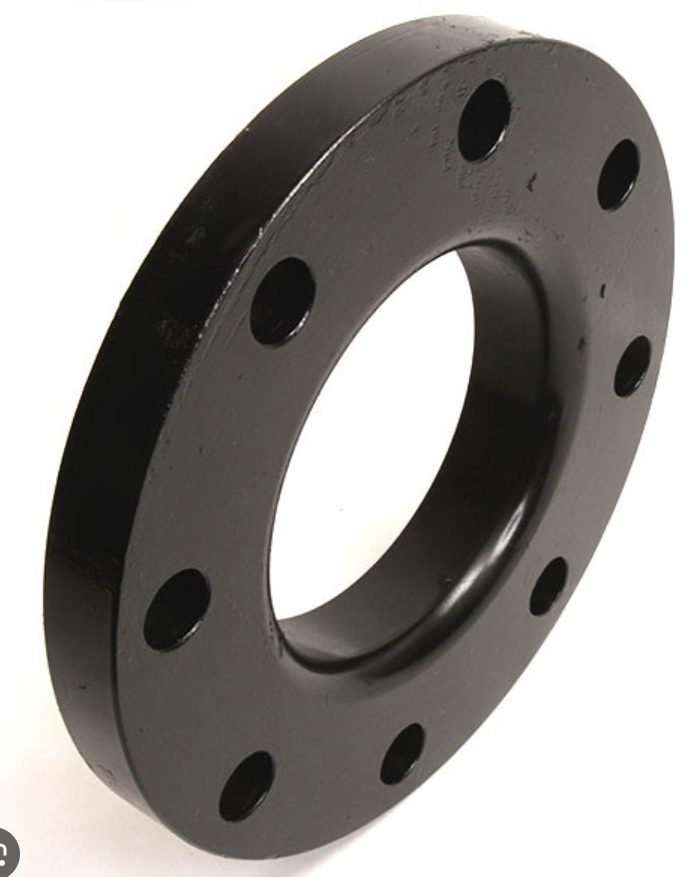
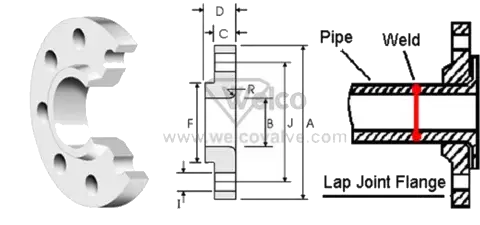
Favored in low pressure applications because it is easily assemble and aligned. These flanges look very similar to a slip on, but the are distinguished by the rounded interior edge of the flange face.
To reduce cost these flanges can be supplied without a hub and/or in treated, coated carbon steel.
Pressure Class Information
These classes include: 150 LBS, 300 LBS, 400 LBS, 600 LBS, 900 LBS, 1500 LBS, and 2500 LBS.
A higher class rating will increase the weight, height, face, and often times change the stud bolts required for installation. Precise dimensions for each flange, by class, can be viewed in our technical flange specification page.
Bolt chart for flanges by class can be seen here
Face Types Available
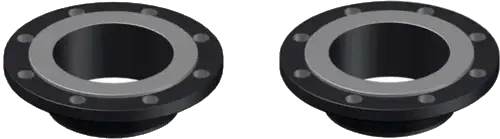
Raised Face
Primary purpose is to concentrate more pressure on a smaller gasket area and thereby increase the pressure containment capability of the joint, creating a more secure connection.
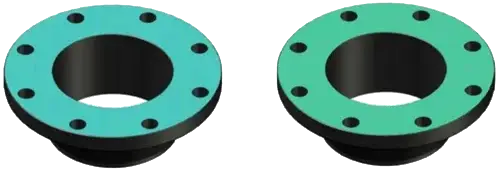
Full Face
Often used in applications where the mating flange or fitting is made from a casting since relatively brittle cast iron requires a full-face contact point.
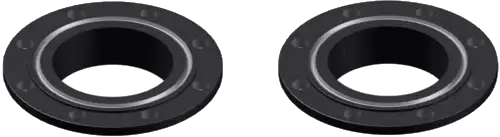
Ring-Type Face
Series A Vs Series B
For flanges above 24", the flange must be specified for either series A or series B. These are competing specifications that were brought together in B16.47. ASME has incorporated most of the MSS-SP44 spec into B16.47 Series A and most of the API 605 spec into B16.47 series B. Weld necks and blinds are covered under these two specs. For slip-ons over 24”, you must refer to either Industry Standard or Boiler Code flanges.
Manufacturers Commonly Available
We can provide flanges from a large selection of manufacturers, with several of them listed below.
| Manufacturer | Country |
|---|---|
| Bebitz | Germany |
| Buffalo Flange | USA |
| DL Flange | USA |
| Galperti Flange | USA/Italy |
| Goodluck Steel | India |
| Kerkau | USA |
| Metalfar | Italy |
| National Flange | USA |
| Technoforge | Italy |
| Trilad | USA |
| Ulma | Spain |
| Viraj | India |
| Weldbend | USA |