
Cut Gasket
A Gasket is a mechanical seal which fills the space between two or more mating surfaces, generally to prevent leakage from or into the joined objects while under compression. Gaskets allow for "less-than-perfect" mating surfaces on machine parts where they can fill irregularities. Gaskets are commonly produced by cutting from sheet materials.
Cut Gasket Products
A Gasket is usually desirable that the Gaskets be made from a material that is compressible such that it tightly fills the space it is designed for, including any slight irregularities. The most common misconception when selecting a cut gasket is to choose a gasket that is too thick. The thicker the material the more likely the material being contained can weep through the pores of the gasket itself. This is a greater issue with some materials than others. A rule of thumb is to have the material thick enough to compensate for any surface face irregularities and to permit some compression.
Inventory
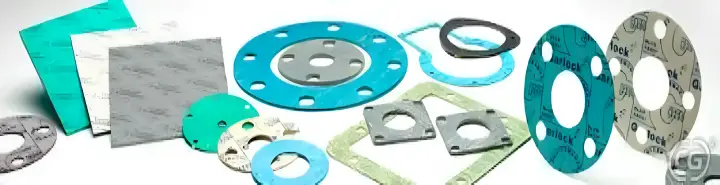
First Distibutors stocks a wide range of gaskets and can have non-stock sizes quickly made to order. The following will commonly be available for same-day or next-day delivery. Quantities may affect lead times.
| Size Range: | 1/4" to 60" Diameter |
| Class: | 150 – 2500 |
| Materials: | Non-Asbestos, Neoprene, Durabla, Garlock, Teflon |
As well as providing products cut to recognized industry standards, First Distributors can also cut gaskets based on your drawing or sample of the gasket you desire. Many factors are taken into consideration when helping you select the right product including temperature, application, media and pressure. First Distributors stocks a wide range of competitively priced, industrial grade gaskets to meet varying specific applications such as high temperature, low load, high torque and high pressure. A comprehensive range of rubber, non-asbestos, virgin and modified PTFE, and graphite grades (industrial and high purity) in sheet, roll and cut gasket forms are available in stock. If you have a cut gasket application that requires more than traditional solutions, let our team of cut gasket professionals help.
Ordering Information
There are some need-to-know details when purchasing cut gaskets, such as: diameter, face type, pressure, material, and material thickness.
Pressure Class
Corresponding to flange pressure classes, cut gaskets are available in 150, 300, 600, 900, 1500, and 2500 pressure classes.
Thickness
Most materials used to stamp cut gaskets are available in either 1/16” or 1/8” thick variations.
Series A vs Series B
Large bore flanges (above NPS 24") to ASME B16.47 Series A or MSS-SP 44 are heavier/stronger than the ASME B16.47 Series B in the same size and pressure rating. In most end-users piping specifications, the Series A is specified, which can withstand more external loadings than the Series B type. For both series, the dimensions are different. From a commercial point of view, the Series B type may be selected for piping with a non-critical application.
Face Type
Cut gaskets may be made to suit either full face or raised face flanges. Since the gasket must span the entire sealing surface of the flange, it is easy to distinguish a full-face gasket from a raised-face gasket.
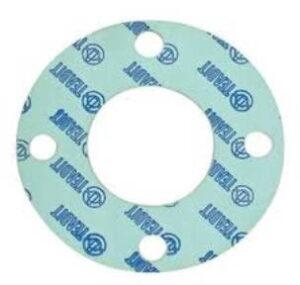
Full Face
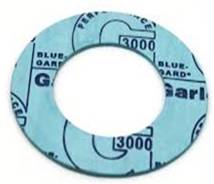
Raised Face (also referred to as a ring gasket)
Material Information
When a sheet of material has the gasket shape "punched out" of it, it is a sheet gasket. This can lead to a crude, fast and cheap gasket. In previous times the material was compressed asbestos, but in modern times a fibrous material such as graphite is used. These gaskets can fill various and different chemical requirements based on the inertness of the material used. Non-asbestos gasket sheet is durable, of multiple materials, and thick in nature. Material examples are mineral, carbon or nitrile synthetic rubber. Applications using sheet gaskets involve acids, corrosive chemicals, steam or mild caustics. Flexibility and good recovery prevent breakage during installation of a sheet gasket.
The following chart shows different manufacturer's names for equivalent gasket materials for three classes of gasket sheeting; Compressed Synthetic Gasketing (CSG), PTFE Sheet, and Flexible Graphite Sheet.
Compressed Synthetic Gasketing (CSG)
| Color | Binder | Fiber | Garlock | Thermoseal-Klinger | Teadit | Durabla |
|---|---|---|---|---|---|---|
| Dark Gray | NBR | In-organic / Aramid | 5500 | C4439 | NA 1090 | No Equal |
| Black | Neoprene | Aramid | 3300 | C5400 / C5401 | NA 1076 | 8700 |
| Black | NBR | In-organic | ST 706 | No Equal | NA 1122 | No Equal |
| Green | NBR | Aramid | 2900 | C4401 | NA 1001 | 8500 |
| Off-white | NBR | Aramid | 2900 | C4401 | NA 1001 | 8500 |
| Off-white | SBR | Aramid | 3200 / 3400 | C6400 / C6401 | NA 1020 | 8600 |
| Blue | NBR | Aramid | 3000 | C4401 | NA 1085 | 8500 |
| Graphite | NBR | Aramid / Wire | No Equal | C4408 | NA 1000M | No Equal |
| Black | NBR | Graphite / Aramid | No Equal | No Equal | No Equal | No Equal |
| Black | NBR | Carbon | 9850 | C4500 | NA 1100 | 8300 |
| Blue | NBR | Glass | No Equal | C4430 | No Equal | No Equal |
PTFE Sheet
| Color | Binder | Filler | Garlock | Thermoseal-Klinger | Flexitallic | Teadit | Durabla |
|---|---|---|---|---|---|---|---|
| Fawn | PTFE | Silica | 3500 | No Equal | 511 | 1590 | No Equal |
| Blue | PTFE | Glass Microsphere | 3504 | No Equal | 500 | 1570 | Durlon 9000 |
| Off-white | PTFE | Barium Sulfate | 3510 | No Equal | 533 | 1580 | 9200W |
| White | PTFE | Expanded Virgin PTFE | 3545 | Soft Chem | 600 | Quimflex SH | 9600 |
Flexible Graphite Sheet
| Insert | Graftech | SGL Polycarbon | Garlock | Thermoseal-Klinger |
|---|---|---|---|---|
| None | GTB | B-Lam | 3123 / 3125 | HL |
| .002” 316ss Foil | GHR | BSSC | 3125 SS | SLS |
| .004” Tanged 316ss | GHE | BTCSS | 3125 TC | PSM |